Many documentary projects and images that photographers capture are controversial pictures. Either the subject is hard to look at, or the story it tells does not fit our ideas of society.
Join us in our 20 most controversial images in the history of photography. Viewer discretion is advised.
25 Most Controversial Photos in the History of Photography
These are our picks for the most controversial photos in photography history. Let us know in the comments if you think we missed one.
Photography has always walked a fine line between documentation and discomfort. Some images shock because of what they show, while others provoke debate over ethics, staging, or political impact. Below are 25 photographs that stirred powerful reactions and continue to spark discussion today.
Controversial pictures have played a powerful role in shaping society. Few moments demonstrate this more clearly than the American Civil Rights Movement between 1954 and 1968.
During this period, racial segregation and discrimination were deeply embedded in everyday life across the United States. One of the most volatile flashpoints was Birmingham. The city became a battleground where Black residents and civil rights activists confronted segregation enforced by local authorities and white supremacist groups.
Among the journalists documenting these events was Charles Moore, a photographer for the Montgomery Advertiser and later for Life magazine. Moore found himself in the middle of demonstrations, arrests, and violent confrontations. His camera did not look away from what was happening in the streets.
One of his most powerful photographs captured police officers using force against peaceful protesters. The image showed segregation not as an abstract policy, but as a brutal daily reality. The violence appeared routine and disturbingly casual, revealing how normalized injustice had become.
When Life magazine published the photographs in 1963, readers across the United States—and around the world—were confronted with undeniable visual evidence of racial oppression. For many Americans, these images were a turning point. They exposed the gap between the nation’s ideals of freedom and equality and the lived experiences of Black citizens in the South.
The public reaction helped build momentum for legislative change. In 1964, the Civil Rights Act of 1964 was passed, outlawing segregation in public places and prohibiting discrimination based on race, color, religion, sex, or national origin.
Photographs like Moore’s did more than document history—they influenced it. They demonstrated how a single frame could challenge denial, shift public opinion, and contribute to meaningful social change.
Untitled (Cowboy) – Norm Clasen vs. Richard Prince
Few photographs have sparked as much debate about authorship and originality as “Untitled (Cowboy)” by Richard Prince. In 2005, one version of the work sold at auction for an astonishing $1 million, immediately igniting controversy across the photography and art worlds.
The core issue is simple but deeply divisive: Is Prince truly the artist behind the image? To this day, there is no universally accepted answer.
A Photograph of a Photograph
What makes this case so complex is that Prince did not create the original cowboy image from scratch. Instead, he rephotographed an existing advertisement photograph. The original image was shot by photographer Norm Clasen, who had been commissioned in the 1970s to produce a series of rugged cowboy visuals for Marlboro’s iconic advertising campaigns.
Clasen’s work helped define the legendary Marlboro Man aesthetic—yet, like many commercial photographers of the era, he received limited public recognition despite the campaign’s massive cultural impact.
The Re-Appropriation Debate
Prince later cropped and rephotographed the advertisement, presenting it as part of his own fine art series. Supporters argue that Prince transformed the meaning of the original image through appropriation, a practice long present in contemporary art. In their view, the act of reframing and contextualizing the photo created a new conceptual artwork.
Critics strongly disagree.
Many photographers and observers see the move as exploitation—profiting from another creator’s labor without meaningful transformation or proper credit. To them, the million-dollar sale highlights ongoing tensions between fine art appropriation and photographers’ rights.
A Pattern of Controversy
This was not an isolated incident. Appropriation has been central to Prince’s career, and several of his works—especially those derived from advertising and social media—have triggered lawsuits, public backlash, and heated debate within the art community.
Because of this history, controversy tends to follow Prince closely. Supporters praise him as a conceptual pioneer who challenges ideas of ownership and originality. Detractors view his work as ethically questionable and dismissive of photographers’ contributions.
Why This Still Matters
The Untitled (Cowboy) debate remains highly relevant today, especially in an era of digital remixing, reposting, and AI-generated imagery. The case forces us to confront difficult questions:
- What counts as original art?
- How much transformation is enough?
- Where is the line between inspiration and theft?
- Who deserves credit—and compensation?
There may never be universal agreement. But one thing is certain: this image permanently changed the conversation about authorship, appropriation, and value in modern photography.
The Face of AIDS (1990) — Therese Frare
In 1990, photographer Therese Frare captured one of the most emotionally powerful images in documentary photography history: The Face of AIDS. Originally shot in black and white, Frare deliberately avoided color so nothing would distract viewers from the photograph’s deeply human message.
At the time, Frare was still a photography student. Gaining access to such an intimate and vulnerable moment is rare even for seasoned professionals, which makes the image even more remarkable.
The photograph shows AIDS activist David Kirby lying on his deathbed, surrounded by his grieving family. His father cradles his head, while his mother and sister comfort one another. The raw emotion—love, grief, and tenderness—radiates from the frame, transforming the image into a universal portrait of loss.
Kirby died shortly after the photograph was taken. During this period, AIDS carried enormous stigma, and public understanding of the disease was limited. In the early 1990s, AIDS was the leading cause of death for U.S. men aged 25 to 44, yet the subject remained widely taboo.
From Photojournalism to Advertising
The controversy intensified two years later when the image was used in a bold advertising campaign by United Colors of Benetton. Creative director Oliviero Toscani selected the photograph as part of Benetton’s strategy to confront social issues through advertising.
Toscani explained that he wanted to address “meaning and issues that advertisers do not normally want to deal with.” For the campaign, the image was colorized to heighten realism and emotional impact.
Public Backlash and Debate
The reaction was immediate and intense. Many viewers were shocked that such a deeply personal and tragic image appeared in connection with a clothing brand. Critics argued the campaign commercialized human suffering, while supporters believed it courageously forced public attention onto the AIDS crisis.
Importantly, Kirby’s family supported the photograph’s publication and its use in raising awareness. Even so, the campaign reignited ongoing ethical questions:
- Should powerful documentary images be used in advertising?
- Where is the line between awareness and exploitation?
- Does context change the meaning of a photograph?
Lasting Impact
Despite — or because of — the controversy, The Face of AIDS became one of the most influential photographs of the AIDS era. Rather than simply promoting United Colors of Benetton, the campaign used the brand’s global visibility as a platform to confront stigma and humanize a misunderstood epidemic.
The image remains a defining example of how controversial photography can challenge silence, provoke public dialogue, and reshape how society confronts difficult issues.
Alexander Litvinenko (2006) – Natasja Weitsz
In 2006, a stark and deeply unsettling portrait of Alexander Litvinenko captured global attention. The photograph, taken by his friend Natasja Weitsz, showed the former Russian security officer frail, bald, and visibly deteriorating in a London hospital bed. Until that moment, Litvinenko’s name was largely unknown outside political circles. After the image spread worldwide, it became impossible to ignore.
Litvinenko had once been a high-ranking officer in the Federal Security Service (FSB), the successor to the KGB. Over time, however, he became an outspoken critic of Vladimir Putin and the Russian government. Facing pressure and threats, Litvinenko fled Russia and sought refuge in the United Kingdom, believing he would be safer there.
That sense of security collapsed in November 2006 after a meeting in London with former associates. Within hours, Litvinenko became violently ill. Doctors later determined he had been poisoned with polonium-210, a rare and highly radioactive substance allegedly slipped into his tea.
A Photograph That Shocked the World
Weitsz’s photograph is powerful not because of action, but because of vulnerability. The once-strong intelligence officer appears almost unrecognizable, his condition making the invisible horror of radiation poisoning suddenly real and human.
The image quickly circulated through international media, transforming Litvinenko’s personal tragedy into a geopolitical flashpoint. For many viewers, the photograph symbolized the perceived reach and ruthlessness of the Russian state.
Controversy and Interpretation
While the world reacted with shock and sympathy, the photograph also carried a darker interpretation. Some analysts suggested the very visibility of Litvinenko’s fate functioned as a warning to other critics of the Kremlin — whether intentional or not.
This dual reading is part of what makes the image so controversial:
- Was it purely documentation of a tragic event?
- Did it unintentionally amplify political intimidation?
- How should journalists handle images tied to suspected state violence?
Lasting Significance
The portrait of Alexander Litvinenko remains one of the most chilling political images of the 21st century. It demonstrates how a single photograph can transform an obscure poisoning case into a global political story.
More broadly, it underscores photography’s unique power: making invisible threats visible, humanizing complex geopolitical conflicts, and forcing the world to confront uncomfortable realities.
Napalm Girl (1972) — Nick Ut
Photojournalism has long played a vital role in informing the public about conflicts around the world. Yet only a handful of images have truly shifted public opinion on a massive scale. One of the most powerful examples is “Napalm Girl,” captured in 1972 by Nick Ut.
During the Vietnam War, newspapers and magazines were filled with disturbing photographs. But few struck the public conscience like this one. The image shows a group of terrified children fleeing a napalm strike, with nine-year-old Phan Thi Kim Phuc at the center, screaming in pain as she runs down the road.
The photograph shattered many Americans’ perception of the war. Rather than distant battlefield heroics, viewers were confronted with the human cost of modern warfare—especially its impact on civilians. The emotional intensity of the image made it impossible to ignore.
Why the Photo Was So Powerful
Several elements combined to give the photograph extraordinary impact:
- Raw human emotion visible in the children’s faces
- Civilian suffering brought to the forefront
- Immediate journalistic credibility from on-the-ground reporting
- Wide publication in major international media
Importantly, Nick Ut did more than take the photograph. After capturing the scene, he helped rush Kim Phuc to a hospital, an act often cited in discussions about the ethics of photojournalism.
Influence on Public Opinion
The image quickly became one of the defining visual symbols of the Vietnam War. While opposition to the war had already been growing, photographs like Napalm Girl intensified public scrutiny and debate in the United States and abroad.
Historians generally agree the photo contributed to shifting public sentiment by:
- Humanizing the war’s civilian toll
- Undermining official narratives of progress
- Fueling anti-war activism
- Increasing pressure on policymakers
The war continued for several more years, but public support in the United States continued to erode during this period.
Lasting Legacy
More than five decades later, Napalm Girl remains one of the most influential photographs ever taken. It is frequently cited in journalism schools as a defining example of photography’s power to reveal uncomfortable truths and shape public conversation.
The image stands as a reminder that photojournalism, at its best, does more than document history—it can help change it.
Thích Quảng Đức (Burning Monk) (1963) — Malcolm Browne
Before the Vietnam conflict officially escalated into full-scale war, tensions were already boiling. In this charged atmosphere, Buddhist monk Thich Quang Duc carried out one of the most shocking acts of protest in modern history.
On June 11, 1963, in Saigon, he publicly self-immolated to protest the persecution of Buddhists by the South Vietnamese government. Present that day was Associated Press journalist Malcolm Browne, who photographed the moment. His image would soon circle the globe.
A World in Shock
At the time, the United States had not yet committed to the large-scale military involvement that would define the Vietnam War, but it was already deeply entangled in the region’s political struggle. Browne’s photograph exposed the severity of internal unrest in South Vietnam and challenged the narrative of stability often presented to the American public.
The image is striking for its stillness. Amid chaos and onlookers, Thích Quảng Đức remained composed in posture. That composure intensified the emotional impact of the photograph and made it one of the most unforgettable protest images ever captured.
Even John F. Kennedy reportedly remarked that no news picture in history had generated so much emotion worldwide. The photograph quickly became a symbol of resistance and a stark warning about the instability brewing in Vietnam.
Did the Protest Change History?
In the immediate sense, the conflict did not end. The war expanded in the years that followed, bringing immense suffering. Yet many historians argue that the photograph planted early seeds of doubt in American public opinion. It forced viewers to confront a deeper question: Was U.S. involvement supporting freedom—or entangling the nation in a complex civil and political struggle?
The Ethics and Power of Protest Imagery
Images like Browne’s continue to raise difficult questions:
- How should the media present extreme acts of protest?
- Does publishing such images honor the protester’s intent—or risk sensationalism?
- Can one photograph truly influence political decisions?
Regardless of differing perspectives, the Burning Monk photograph remains one of the most powerful examples of visual protest in history. It demonstrates how a single frame can transcend borders, challenge governments, and permanently alter the global conversation.
First Woman to Officially Run the Boston Marathon (1967) — Boston Herald
In 1967, Kathrine Switzer made history at the Boston Marathon—and a photograph captured the exact moment the world realized change was coming.
At just 20 years old, Switzer registered for the race using her initials, “K.V. Switzer,” to avoid drawing attention. At the time, the marathon was officially limited to men. Although Roberta Gibb had run the course unofficially the year before, Switzer became the first woman to enter with an official bib number.
Organizers and much of the public believed women were physically incapable of completing a marathon. The idea of female endurance athletes was widely dismissed.
The Moment That Shocked the World
During the race, as photographers from a press bus documented the unusual sight of a woman running, race official Jock Semple noticed Switzer on the course. In a now-famous scene, he ran toward her and attempted to tear off her race number, shouting for her to get out of “his” race.
The confrontation was captured in dramatic photographs published by the Boston Herald and other outlets. Switzer’s boyfriend, Tom Miller, intervened and blocked Semple, allowing her to continue.
The images quickly spread across newspapers worldwide. They showed not just a race, but a physical attempt to remove a woman from public athletic participation.
Finishing What She Started
Switzer made a crucial decision that day: she would not quit. She later explained that stopping would make the run look like a publicity stunt. By finishing the marathon, she proved women were fully capable of enduring the 26.2-mile challenge.
The controversy sparked debate about gender discrimination in sports. Just five years later, in 1972, women were officially allowed to compete in the Boston Marathon.
Why the Photo Matters
The photograph of Jock Semple lunging at Kathrine Switzer remains one of the most iconic sports images of the 20th century. It symbolizes:
- The fight for gender equality in athletics
- The power of media to expose discrimination
- How a single image can accelerate social change
Cotton Mill Girl (1908) — Lewis Hine
At the start of the 20th century, child labor was still widespread across the United States. Sending young children to work in mills, factories, and mines was considered normal in many industries. Photographer Lewis Hine helped change that reality with images that were impossible to ignore.
Before turning fully to photography, Hine taught sociology. His interest in social reform led him to document working conditions across America. In 1908, he became the official photographer for the National Child Labor Committee, combining investigative reporting with powerful visual storytelling.
Risking Exposure to Reveal the Truth
Hine traveled extensively with a bulky large-format camera, visiting mills and factories where child labor was common. Photography was often forbidden in these workplaces, forcing him to use creative—and risky—methods to gain access.
At times, he posed as a Bible salesman or claimed to be an industrial photographer documenting machinery. Despite the challenges, he succeeded in capturing stark, honest images of working children.
One of the most famous is Cotton Mill Girl, showing young Sadie Pfeifer standing beside a massive cotton-spinning machine in Lancaster, South Carolina. The contrast between the child’s small frame and the towering industrial equipment made the message unmistakable.
Why the Photograph Shocked the Public
Many Americans already knew, in theory, that children worked in factories. What Hine’s photographs did was make the reality visible and personal. The images were:
- Direct and unembellished
- Emotionally compelling
- Supported by careful field notes
- Widely circulated in reports and publications
Their raw honesty stirred public concern and strengthened the growing reform movement.
Real Legislative Impact
Hine’s work became a powerful tool in the campaign against child labor. While change did not happen overnight, his photographs helped build sustained political pressure.
Key milestones followed:
- In 1912, the United States Children’s Bureau was established to investigate child welfare.
- In 1938, the Fair Labor Standards Act of 1938 set nationwide limits on child labor and established minimum wage and hour protections.
Lasting Legacy
Cotton Mill Girl remains one of the most influential social documentary photographs ever made. It demonstrates how determined photojournalism can expose normalized injustice and help drive long-term reform.
Lewis Hine didn’t just document history—he helped change it, one photograph at a time.
Iraqi Girl at Checkpoint (2005) — Chris Hondros
In 2005, during the height of the Iraq War, photojournalist Chris Hondros captured a haunting image that would shock the world: Iraqi Girl at Checkpoint.
The photograph shows Samar Hassan, moments after her parents were tragically killed at an American military checkpoint while returning home from Tal’ Afar. Soldiers, fearing hidden insurgents in the car, opened fire. Such incidents were disturbingly common, but rarely documented in real time.
Hondros, embedded with U.S. forces, instinctively turned his lens toward the children as the tragedy unfolded. His images were transmitted immediately and published globally the next day, drawing instant attention to the human cost of the war.
Impact and Controversy
The image sparked immediate debate and scrutiny:
- The U.S. military revised checkpoint procedures to prevent similar tragedies.
- International media questioned why forces meant to liberate civilians were causing civilian casualties.
- The photograph became one of the most emotionally charged images of the Iraq War, often described as allowing viewers to “hear the girl’s scream.”
Iraqi Girl at Checkpoint demonstrated the power of photography to hold governments accountable, provoke public debate, and humanize the cost of conflict.
Sí, Quiero (2013) — Gonzalo Orquín
Photography’s capacity to challenge social norms is evident in Gonzalo Orquín’s 2013 series Sí, Quiero. Unlike war photography, Orquín’s work addresses culture, religion, and civil rights.
The series features gay and lesbian couples kissing inside Roman Catholic churches in Rome, a bold confrontation of traditional religious norms. The photographs were intended for the “Trialogo” exhibition at Galleria L’Opera, but Vatican officials threatened legal action, citing violations of the Italian Constitution.
Ultimately, the exhibition was canceled “for security reasons,” but the images endure as a provocative statement. Orquín captured love, unity, and public devotion while sparking controversy, highlighting photography’s unique power to question societal and institutional norms.
Both Iraqi Girl at Checkpoint and Sí, Quiero illustrate how photography can provoke debate, challenge authority, and bring hidden realities or marginalized perspectives into public view. These images remain some of the most controversial and influential in modern photography.
Immersions (Piss Christ) (1987) — Andres Serrano
Few artworks have sparked as much controversy as Piss Christ, part of the Immersions series by Andres Serrano. Created in 1987, the photograph depicts a small crucifix submerged in the artist’s urine—a provocative act intended to challenge viewers’ perceptions of sacred symbols.
The image was first exhibited in New York as part of the Immersions series, which explored various objects immersed in fluid. Its controversial nature escalated in 1989 when it was revealed that the exhibition had received funding from the National Endowment for the Arts, a government-funded institution.
Public Outcry and Political Fallout
The photograph was immediately condemned by religious leaders as blasphemous. One pastor in particular campaigned vigorously against the artwork, attracting national attention. The controversy grew so intense that members of the United States Congress became involved. The debate ultimately contributed to the passing of legislation aimed at limiting federal funding for art deemed offensive.
Why It Remains Controversial
Piss Christ raises questions that continue to fuel debate today:
- What constitutes artistic freedom versus disrespect?
- Should taxpayer money fund provocative or offensive art?
- Can shock value itself be considered a legitimate form of artistic expression?
Regardless of opinion, Serrano’s work is a defining example of how photography and conceptual art can provoke public debate, challenge cultural norms, and force society to confront uncomfortable questions about religion, art, and censorship.
The controversy surrounding Piss Christ and other NEA-funded works, like those of Robert Mapplethorpe, led to direct government intervention. A new law required the National Endowment for the Arts to consider “general standards of decency” before awarding grants.
The debate quickly divided the nation. Critics argued that the government was overstepping by effectively censoring art, while supporters claimed public funding should reflect community values. The central question became: Does the U.S. government have the right to dictate what qualifies as acceptable art?
Despite the backlash, these artists opened doors for others to challenge boundaries in visual art. Their work helped establish that fine art photography could be created and interpreted without fear of legal restriction. In 1998, the U.S. Supreme Court overturned the law, reaffirming artists’ freedom of expression and solidifying a legacy of creative independence for future generations.
Thanks to Serrano and Mapplethorpe, photography today can explore provocative, controversial, and challenging themes without legal censorship, allowing artists to push cultural and societal limits.
In the Shadows of Kolkata (1978 / 2017) — Mary Ellen Mark and Souvid Datta
Documentary photography is often celebrated for its honesty and raw depiction of real life. Yet, in recent years, award finalists have faced increasing scrutiny for alleged manipulation and ethical breaches. Cases such as David Byrne losing recognition for excessive editing, or Giovanni Troilo having awards revoked for misleading captions, highlight just how seriously the photography community treats authenticity.
One of the most notorious controversies involved Souvid Datta and Mary Ellen Mark. Datta, an award-winning photographer, submitted a project titled In the Shadows of Kolkata, a series documenting sexual violence in Kolkata. He promoted the images as part of a major photography contest.
The Controversy
Datta claimed that the woman in the background of one photograph was a veteran sex worker named Asma. However, curator Shreya Bhat noticed something troubling: the woman appeared identical to a subject in a photograph by Mary Ellen Mark, captured in Bombay in 1978—nearly forty years earlier.
It became clear that Datta had digitally inserted Mark’s subject into his own image. This manipulation violated fundamental principles of documentary photography, which depend on truthful representation.
Consequences
The fallout was swift and severe:
- Datta lost numerous awards and professional credibility.
- His reputation in the documentary photography world was deeply damaged.
- The controversy sparked broader discussion about the ethics of image manipulation in photojournalism.
The Larger Lesson
Cases like this illustrate why documentary photography is held to such strict standards. Unlike conceptual or artistic photography, documentary work is expected to reflect reality without alteration. Manipulating images undermines public trust and calls into question the very purpose of the genre.
Today, after incidents like Datta’s, many organizations review submissions with heightened vigilance. The controversy surrounding In the Shadows of Kolkata serves as a cautionary tale: authenticity, transparency, and ethical practice are essential in documentary photography.
It also reminds the world of Mary Ellen Mark’s enduring legacy, whose work continues to inspire generations of photographers committed to truth in storytelling.
Falling Man (2001) — Richard Drew
For many who lived through September 11, 2001, the image of the “Falling Man” is instantly recognizable. Unlike most photographs of the attacks, which focus on the planes and towers, this photograph by Richard Drew captures the human cost in a profoundly personal way.
The photograph shows a man plummeting from the North Tower of the World Trade Center, moments before his death. Newspapers initially published the image, but the public reaction was intense. Many readers were shocked and uncomfortable, leading editors to pull it from circulation for a time.
Why It Is Controversial
Falling Man is controversial for several reasons:
- It depicts someone on the brink of death, forcing viewers to confront mortality directly.
- Unlike graphic war or disaster photography, there is no blood or gore—yet the human tragedy is undeniable.
- The image emphasizes the impossible choices victims faced: remain inside a burning building or jump to their death.
The Mystery of Identity
The man in the photograph has never been conclusively identified. Some speculate he may have been an employee at Windows on the World, but this remains uncertain. His anonymity echoes the concept of the “Unknown Soldier,” representing countless innocent victims of history who die unnoticed or unidentified.
The Lasting Impact
Despite—or because of—its quiet, haunting composition, Falling Man forces viewers to reflect on the human dimension of tragedy. It is not just a record of 9/11; it is a memorial to individual lives lost and the ethical dilemmas faced by victims in extreme circumstances.
The photograph remains one of the most haunting and controversial images in modern history, a reminder of the personal stories behind global events.
Bosnia (1992) — Ron Haviv
Photojournalist Ron Haviv is widely known for his courageous coverage of the Yugoslav Civil Wars, particularly in Bosnia. His images documented ethnic violence that much of the world preferred to ignore, often putting his own life at risk.
During the Bosnian War, Haviv followed Arkan’s Tigers, a Serbian nationalist volunteer militia. While the group allowed him to photograph them for propaganda purposes, he was explicitly prohibited from capturing acts of murder or brutality. Despite these restrictions, Haviv witnessed atrocities against Bosniaks firsthand.
Capturing Atrocity
The photograph known as Bosnia (1992) resulted from a split-second decision by Haviv. He documented the violence and cruelty that unfolded in front of him, knowing that failure to act could let these crimes remain invisible, while acting could cost his life.
His work did more than expose brutality—it became part of the historical record. Images like this provided evidence against perpetrators of ethnic cleansing, including Željko Ražnatović (commonly known as Arkan). Arkan was indicted for crimes against humanity, though he was assassinated before the verdict could be carried out.
Legacy
Haviv’s photograph stands as a chilling reminder of the human cost of war and the importance of documenting atrocities, even under extreme personal danger. It exemplifies how photojournalism can bear witness, hold perpetrators accountable, and ensure that the world cannot claim ignorance when injustice occurs.
Bosnia (1992) remains one of the most controversial and vital images of modern conflict, showing the moral courage required to reveal uncomfortable truths.
Famine in Somalia (1992) — James Nachtwey
Renowned photojournalist James Nachtwey captured one of the most haunting and influential images of modern humanitarian crises in 1992. During the devastating famine in Somalia, Nachtwey documented the catastrophic effects of war and instability on civilian populations, exposing the world to a crisis often overlooked.
Gaining Access
Unlike typical assignments, Nachtwey secured access largely on his own. After approaching news outlets with the idea of covering the famine, he struggled to get support. Eventually, with assistance from the International Committee of the Red Cross, he entered Mogadishu to document the conditions firsthand.
The Photograph
The iconic image shows a frail woman being transported in a wheelbarrow toward a feeding center. Too weak to walk, she extends her arm, silently pleading for aid. The photograph is striking in its simplicity—no sensationalism, no dramatization—yet it conveys the desperate human suffering caused by famine and conflict.
Global Impact
Nachtwey’s work quickly appeared in the New York Times and captured global attention. Unlike war photography that highlights battles or military action, Nachtwey’s series drew focus to the famine—a secondary, but equally devastating consequence of armed conflict.
The public response was unprecedented: his images helped catalyze the largest humanitarian aid operation since World War II, bringing food, medicine, and attention to millions of Somalians in need.
Why the Images Were Controversial
While not controversial in the sense of political debate, Nachtwey’s photographs sparked ethical and emotional discussion:
- Should journalists intervene directly or remain observers?
- How should the media present extreme human suffering without exploiting subjects?
- Can a photograph mobilize public action in ways written reports cannot?
Ultimately, Nachtwey’s work demonstrates the profound power of documentary photography. Famine in Somalia is a testament to how visual storytelling can awaken global empathy, provoke urgent humanitarian response, and forever change the way the world responds to crisis.
Dying Polar Bear (2015) — Kerstin Langenberger
In mid-August 2015, photographer Kerstin Langenberger captured a striking and unsettling image of a severely emaciated polar bear near Svalbard. The bear appeared so thin that it was hard to recognize at first, its frail frame a stark contrast to the iconic image of Arctic wildlife.
Capturing the Moment
Langenberger was on an Arctic nature tour when she first noticed the bear from her boat. Initially unsure of what she was seeing, she realized only when it stood up that it was indeed a polar bear—though in a state of extreme malnutrition.
The photograph immediately drew attention for its emotional impact and symbolic resonance. Langenberger suggested that the bear’s starvation might be connected to climate change, highlighting the effect of melting sea ice and shrinking hunting grounds on Arctic wildlife.
Public Reaction
After posting the image on Facebook, discussions erupted. Some viewers questioned the direct link between the bear’s condition and climate change, arguing that other factors, such as disease or age, could also contribute. Polar Bears International issued a statement cautioning that Langenberger’s claim was “a bridge too far,” emphasizing that the photograph alone could not conclusively demonstrate causation.
Ethics and Influence of Photography
This case illustrates how even wildlife photography can become controversial. Once an image enters the public domain with interpretive text, it can strongly influence public perception—sometimes beyond what the evidence supports. Biases and narratives attached to images can shape debates, emotions, and policy discussions.
Legacy
Dying Polar Bear serves as both a powerful visual document of Arctic wildlife in distress and a reminder of the responsibility that comes with sharing images. While it sparked debate over climate change and interpretation, it also reinforced photography’s ability to provoke thought, raise awareness, and generate public discourse on urgent global issues.
Rhein II (1999) — Andreas Gursky
At first glance, Rhein II by Andreas Gursky appears deceptively simple: a minimalist landscape featuring soft horizontal lines of river, grass, and sky. Its restrained composition and serene aesthetic make it a modern icon of photographic minimalism.
The Controversy
The controversy, however, isn’t about the image itself—it’s about the price. In 2011, Rhein II sold at Christie’s Auction House for a staggering $4,338,500, making it the most expensive photograph ever sold at the time. While later sales have surpassed this, the record sparked widespread debate.
Critics questioned whether any photograph—even a masterful one—could justify such a price. Unlike paintings, photographs can be reproduced. Once a print is sold, the artist can create additional copies, making the notion of exclusivity less straightforward than in traditional fine art.
Why It Matters
The sale of Rhein II ignited discussions about the value of photography as collectible art:
- Should reproducibility limit the market value of photographs?
- Does conceptual or aesthetic significance justify extreme prices?
- How do collectors assign financial value to images compared to paintings or sculptures?
Legacy
Regardless of opinions on its price, Rhein II remains a landmark in contemporary photography. Its minimalist elegance and conceptual approach have inspired countless artists, while the record-breaking sale raised important questions about the commercialization of photographic art.
Gursky’s work exemplifies how photography can transcend documentation, becoming both a visual masterpiece and a lightning rod for debates about art, money, and cultural value.
Comrade Stalin and Nikolai Yezhov (1917) — Unknown
One of the most striking examples of historical photo manipulation comes from the early Soviet era. In the original photograph, Joseph Stalin stands alongside Nikolai Yezhov, the head of the NKVD (secret police). However, in later versions, Yezhov was removed entirely, leaving only Stalin—a deliberate erasure of historical record.
The Historical Context
Between 1937 and 1938, the Soviet Union underwent the Great Purge, a period during which thousands of military officers, party members, and perceived opponents were imprisoned or executed. Yezhov was a central figure in these purges, responsible for ordering the arrest of approximately 1.3 million people, with half executed for “crimes against the state.”
Ironically, Yezhov himself eventually became a victim. Denounced, imprisoned, tortured, and executed in 1940, he was posthumously erased from photographs and official histories—a practice that exemplified the regime’s control over both memory and visual documentation.
The Power of Image Manipulation
This photograph illustrates how controversial images can alter perception of history:
- Evidence of key figures can be removed or altered.
- Entire narratives of events can be rewritten visually.
- Future generations may inherit a manipulated understanding of the past.
Even in the era of film photography, political leaders understood the power of images to shape reality. The Stalin-Yezhov photograph is a chilling reminder that photography, often seen as a record of truth, can be weaponized to control memory, manipulate public perception, and rewrite history.
The Torture of Ali Shallal al-Qaysi (2004) — Unknown
In 2004, the world was confronted with shocking images from Abu Ghraib Prison, exposing the brutal treatment of prisoners under American occupation following the 2003 invasion of Iraq. Among the most infamous was the photograph of Ali Shallal al-Qaysi, tortured while in custody.
The Context
Al-Qaysi had been peacefully protesting the U.S. invasion of Iraq. He owned a football pitch that had been repurposed by soldiers to dispose of injured bodies. Seeking to expose the use of prohibited weapons, he attempted to guide journalists to evidence of these abuses. For his actions, he was arrested and taken to Abu Ghraib, where he endured days of physical and psychological torture.
Reflecting on his ordeal, Al-Qaysi later said:
“I’m spending sleepless nights thinking about the agony I went through… I even have recurring nightmares that I’m in my cell at Abu Ghraib, cell 49 as they called it, being tortured at the hands of the people of a great nation that carries the torch of freedom and human rights.”
The Impact
The photograph of Al-Qaysi’s torture became a symbol of the human cost and moral controversies of the Iraq War. It revealed to the public, for the first time, the treatment of detainees and the dark realities of military occupation.
- The image sparked international outrage and debates over military conduct and accountability.
- It highlighted how photography can bring hidden atrocities into global awareness.
- It serves as a reminder that visual documentation can carry immense ethical weight, shaping historical memory and public perception.
Legacy
These images from Abu Ghraib, including that of Ali Shallal al-Qaysi, remain among the most controversial photographs of the early 21st century. Beyond controversy, they compel reflection on human rights, ethics in warfare, and the enduring responsibility of witnesses to document and report injustice.
Alan Kurdi (2015) — Nilüfer Demir
Few images in recent memory have left as deep an imprint on the world as the photograph of Alan Kurdi, captured by Nilüfer Demir. Taken in 2015 during the height of Europe’s refugee crisis, the image shows the lifeless body of three-year-old Alan washed up on the shore of Bodrum.
The Context
War and violence in Syria forced countless families to flee, seeking safety in Europe. The European Union struggled to manage the unprecedented influx of refugees, often closing borders and limiting access. Many migrants risked dangerous journeys by boat from Turkey to Greece.
Tragically, the Kurdi family’s boat capsized shortly after departure from Kos, drowning Alan, his brother, and their mother.
Capturing the Moment
Demir, working with the Dogan News Agency, arrived at the shore and photographed Alan’s body. She later explained:
“There was nothing left to do for him. There was nothing left to bring him back to life. I thought this is the only way I can express the scream of his silent body.”
The image, raw and heartbreaking, quickly circulated on social media, bringing the human cost of the refugee crisis into stark relief.
Global Impact
The photograph prompted widespread outrage and forced policymakers to confront the human consequences of border closures and restrictive asylum policies:
- European governments temporarily opened frontiers to refugees.
- The image sparked debates about responsibility, ethics, and humanitarian obligations.
- It became a symbol of the refugee crisis, representing millions of silent victims.
Legacy
As one of the most controversial and emotionally charged photographs of the 21st century, Alan Kurdi underscores the power of photography to expose systemic failure, provoke social action, and demand accountability. It is a haunting reminder that behind statistics are human lives, each with their own story.
Nan One Month After Being Battered (1984) — Nan Goldin
American photographer Nan Goldin is celebrated for her unflinching documentation of intimacy, identity, and marginal communities. Her work spans the LGBTQ+ experience, the HIV crisis, and the opioid epidemic, always presenting life as it is—raw, personal, and deeply human.
The Photograph
Nan One Month After Being Battered is a striking and controversial example of Goldin’s approach. The image captures Goldin herself, showing the aftermath of a violent attack by a partner with whom she had a complex, intense relationship. Her bruised and bloodied eye is unmistakable, yet she appears poised, with styled hair, red lipstick, and jewelry, suggesting a refusal to let violence define her presence or identity.
Why It Is Controversial
The photograph confronts viewers with multiple uncomfortable truths:
- Violence against women is depicted candidly, a topic often considered taboo.
- The image blurs lines between personal documentation, evidence, and portraiture, raising questions about voyeurism and consent.
- Goldin’s ability to present trauma alongside beauty challenges traditional notions of photography and storytelling.
Cultural and Artistic Impact
Goldin’s work, including this photograph, forces audiences to confront societal discomfort around domestic violence and the resilience of survivors. The image bridges documentary realism with aesthetic composition, showing how art can reflect both suffering and defiance.
By sharing her personal experience, Goldin not only documents a painful moment in her life but also gives voice to wider conversations about abuse, agency, and identity. Nan One Month After Being Battered remains one of the most controversial and thought-provoking photographs of the 20th century, redefining what photography can reveal about human struggle and endurance.
Candy Cigarette (1989) — Sally Mann
Renowned American photographer Sally Mann earned the title “America’s Best Photographer” from Time Magazine in 2001. She is best known for her collection Immediate Family, which controversially documented her children, including intimate portraits—around 25% of which were nude. These images sparked debates over the boundaries between fine art, pornography, and objectification.
Candy Cigarette is one of the most debated photographs from the series. It shows Mann’s daughter, Jessie, holding a candy cigarette and gazing directly into the camera. While the object isn’t real, the image evokes tension: an innocent child posed with an adult gesture, making viewers confront the blurred lines between childhood innocence and adult behaviors.
Critics have argued the photograph is provocative, while supporters praise Mann’s use of light, composition, and psychological depth. The image encapsulates the idea of choice—Jessie could take a “right” or “wrong” path, symbolically foreshadowing adulthood. Viewers experience a protective instinct, a desire to preserve childhood while acknowledging the inevitable passage of time.
Candy Cigarette remains a compelling example of how photography can evoke moral, emotional, and aesthetic questions simultaneously, securing its place among the most controversial images in modern art.
The Falling Soldier (1936) — Robert Capa
Robert Capa is one of the most famous war photographers in history, known for capturing the raw intensity of conflict. The Falling Soldier depicts a soldier being shot during the Spanish Civil War, falling backward as his rifle slips from his hands. Taken during the Battle of Cerro Muriano on September 5, 1936, the photograph shocked audiences worldwide.
Controversy
Since the 1970s, debate has surrounded whether the image was staged. While Capa insisted he captured the moment spontaneously from a trench, critics note inconsistencies:
- The precision of the shot seems almost too perfect for a split-second battlefield moment.
- Some details of location and timing remain disputed.
- Staged photography was not uncommon during the Spanish Civil War.
Capa recounted:
“I was there in the trench with about twenty milicianos… I just kind of put my camera above my head, and even didn’t look and clicked the picture when they moved over the trench. And that was all. … [T]hat camera which I hold above my head just caught a man at the moment when he was shot. That was probably the best picture I ever took. I never saw the picture in the frame because the camera was far above my head.”
Legacy
Despite lingering questions about its authenticity, The Falling Soldier remains one of the most iconic and discussed war photographs ever taken. Its power lies in its immediacy and the raw depiction of mortality, cementing its status as a controversial yet enduring image in the history of photography.
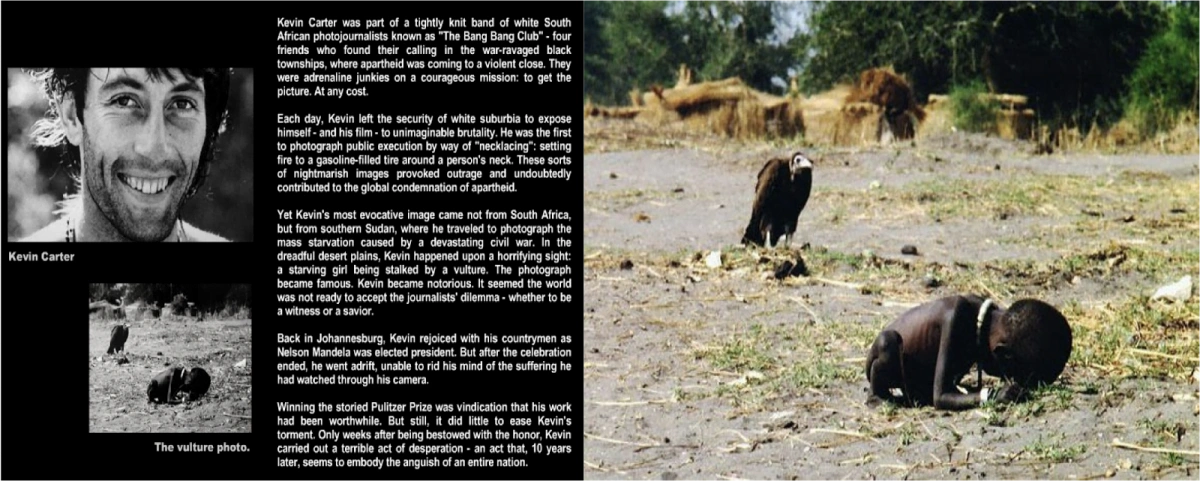
Starving Child and Vulture (1993) — Kevin Carter
South African photographer Kevin Carter was a member of the renowned “Bang-Bang Club,” a group of photographers documenting the violence and hardship of South African townships during the final years of apartheid (1990–1994). In 1993, Carter traveled to South Sudan to cover the devastating famine, where he captured one of the most controversial photographs in modern journalism: a starving child crouched on the ground while a vulture lurks ominously nearby.
Global Impact
The photograph was published in The New York Times in March 1993 and quickly sparked worldwide attention. Its harrowing depiction of human suffering became a symbol of famine and neglect, prompting urgent discussions about global responsibility. The image went on to win the Pulitzer Prize for Feature Photography, cementing its place in photographic history.
Controversy
Despite its acclaim, the photograph sparked intense ethical debate. Critics and the public questioned why Carter did not intervene to help the child, focusing on the moral responsibilities of photojournalists in crisis situations. The scrutiny weighed heavily on him, compounding the psychological toll of years spent documenting violence and suffering. Tragically, Carter took his own life four months after receiving the Pulitzer Prize.
Importance of Controversial Photography
Images like Starving Child and Vulture challenge viewers to confront realities they might otherwise ignore. While a photograph captures only a fraction of a story, its power lies in evoking empathy, outrage, and reflection. Controversial photos push societies to reconsider their worldview, highlighting injustice, human vulnerability, and the ethical complexities of witnessing suffering.
Conclusion
Photography has repeatedly proven its ability to provoke, challenge, and inspire change. From documenting wars and famine to exposing climate crises and human rights abuses, controversial photographs force us to face uncomfortable truths. Some images make us angry, others make us feel guilt or shame, but all of them remind us that photography is not just art—it is a mirror reflecting the world as it truly is.
Frequently Asked Questions (FAQ) – Most Controversial Photos in Photography History
1. What makes a photograph “controversial”?
A photograph becomes controversial when it challenges societal norms, exposes injustice, depicts extreme suffering, or raises ethical questions. Controversy can stem from content, context, or the method of capture.
2. Are all the photos in the list real events or staged?
Most images document real events. However, some—like The Falling Soldier by Robert Capa—have sparked debates over whether they were staged or manipulated. The controversy often amplifies the discussion around authenticity in photography.
3. Can controversial photos change society?
Yes. Many photographs, such as Nick Ut’s Napalm Girl or Kevin Carter’s Starving Child and Vulture, have influenced public opinion, policy decisions, and humanitarian action. They force viewers to confront realities often hidden from daily life.
4. Are these photos suitable for all audiences?
Many images on the list depict violence, suffering, or sensitive topics. Viewer discretion is advised, especially for children or sensitive individuals.
5. Why do some photographers face criticism for taking these images?
Photographers are sometimes accused of exploitation, voyeurism, or failing to intervene in crises. Ethical debates arise over the balance between documenting reality and offering assistance.
6. Do these photographs depict only wars?
No. While many focus on war (Falling Man, Famine in Somalia), others address social issues, domestic violence (Nan One Month After Being Battered), climate change (Dying Polar Bear), art controversies (Rhein II), and historical manipulation (Stalin and Yezhov).
7. Who decides which photographs are controversial?
Controversy often emerges through public, media, or academic reaction. It can also come from legal, religious, or political authorities, depending on the image’s impact and context.
8. How did awards like the Pulitzer affect these photographs?
Awards like the Pulitzer Prize (Starving Child and Vulture) amplify visibility and influence, but can also increase public scrutiny and ethical debate.
9. Are controversial photographs always graphic or shocking?
Not always. Some, like Andreas Gursky’s Rhein II, provoke controversy through pricing, concept, or artistic interpretation rather than graphic content.
10. Can these images be used in education or research?
Yes. They are often studied in journalism, photography, history, sociology, and ethics courses to understand storytelling, visual impact, and societal influence.
11. How do photographers decide to take such risky or sensitive images?
Most documentary photographers aim to reveal truth, raise awareness, or document history. They weigh risks, consent, and ethical considerations before capturing sensitive moments.
12. Where can I view these controversial photographs?
Many are published online in museums, galleries, news archives, and photography books. Some images remain restricted due to graphic content or copyright.
13. Why do some photos continue to be controversial decades later?
Controversy often endures when images expose systemic issues, challenge norms, or remain ethically debated. Historical and societal context can prolong their relevance.
14. Are controversial photos illegal to take or publish?
It depends on context and jurisdiction. Most controversial photographs are legal if they document public events or newsworthy situations, though laws may vary regarding nudity, privacy, or national security.
15. What is the role of social media in controversial photography?
Social media accelerates exposure, public discussion, and debate. It can make controversial photographs viral, amplifying their social and political impact.